What's your favourite book?
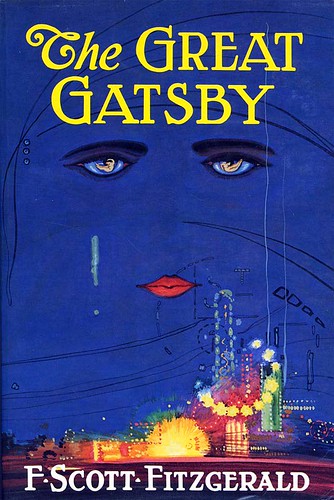
Now, I've read a lot of books. And I've enjoyed a lot of books. I've read books that have made me happy, books that have made me sad, and books that have changed me so profoundly that I owe who I am today to them. So I don't understand why I receive weird looks whenever I start rattling off a list that is being revised as it's said. But if I had to choose, at gun point, knife point or wand point, I would choose Gatsby.
Even though I grew up at Hogwarts.
Even though Holden stopped me from committing suicide.
Even though Augustus Waters made me cry for 20 minutes
and even though Julia Forester made me see what a real heroine was like.
Gatsby's my book. My favourite. My Gatsby.
And with the movie coming out next year as well as there being so many hate posts about it, I want to explain to you what makes Gatsby so Great.
First what it means: Symbolism and what we can take from this book. Then we'll do some proper close reading.
If you're on the anti-lit brigade (Metaphres are stupid! OMG that's not what the author intended! Everyone is just making stuff up! This has no value in the real world!):
This is John Green. This is an author. He puts symbolism in his books. He thinks that critical reading is important. He loves Gatsby as much as I do.
From here:
You often hear in high school English classes, for instance, that thinking about symbols is dumb or useless or “ruining the book.” But underneath it all, this is why we have language in the first place. We don’t really need language to share the news of your back pain: You can point at your back and grimace to tell me that your back hurts, and I can nod sympathetically.
But to explain to you the nature and nuance of my grief or pain or joy, I need abstractions. I need symbols. And the better our symbols are, the more clearly we’ll be able to communicate with each other, and the more fully we’ll be able to imagine each other’s experience. Good symbolism makes empathy easier.
So why the strings? The strings inside a person breaking struck me as a better and more accurate abstract description of despair than anthropomorphized symbols (broken heart, etc.).
And this is very important to remember when reading or writing or painting or talking or whatever: You are never, ever choosing whether to use symbols. You are choosing which symbols to use.
You are the composite of a hundred thousand different symbols. Every word, every gesture. The food you eat, your clothes, your hair, your make-up. All of it is symbolic. All these things add up to who you are and how you'd like to been seen. Your gender, your sexuality, your class and your taste and how you relate to others. Nothing you do is not symbolic in some way. It might seem like it isn't because the meanings of what you are doing are so indexed into society that they are transparent, but trust me, they are. And most of these are symbols that you choose.
But how does this wishy-washy liberal arts shit help you love The Great Gatsby?
Because, as Nick Points out, in chapter three, "most affectations conceal something eventually".All the characters have affectations, all the characters are hiding something. Gatsby has his "old sport" to try and hide the fact that he's New Money. Daisy has her cool, melodic exterior to hide her inner discontent. Jordan acts haughty with her head thrown back, to show the world how cool and unaffected she is by life, her confidence hides her cheating and carelessness. Nick stays silent and polite to hide his disgust with the crowd he goes along with.
Tom... well Tom doesn't hide much. But Tom is also the biggest asshat on the planet.
And that's a point that can be brought up in this book. Is it arguing that everyone on the inside is just as ugly and unbearable as Tom? Certainly the character's inner selves do not serve much as role models. Can we project that to our lives? Underneath our clothes and hair and choices are we all bitter Daisy Buchanans and arrogant Toms, careless Jordans and prideful Nicks?
That, my dear reader, is up to you. I'm not going to tell you what to take away from a book or how to view humanity.
But as Nick says, and as John Green points out, Gatsby has an "extraordinary gift for hope". I take The Great Gatsby as a novel about hope. The ending is irrelevant, to an extent. "All lives end. All hearts are broken". That's life. It's a sad part of life, but it is inescapable. It's what you make of life that matters, not how much money you have, and that's something which provides contention in the book.
It's also the American Dream. That we can all be successful, no matter our class or standing. Except, as shown in the book, if you measure success by monetary value, things don't turn out too well.
Gatsby, to me, is a hopeful book that faces the human condition with a simple honesty. How do I come to this conclusion? Because of Nick.
“And so with the sunshine and the great bursts of leaves growing on the trees, just as things grow in fast movies, I had that familiar conviction that life was beginning over again with the summer.”We are all the narrators of our own stories. We all go to mystical places, like the party at Gatsby's. We all experience such strange and wonderful things. And sometimes they end. But it's not always the end. The difference between Gatsby's death, Tom and Daisy's evacuation and the break up with Jordan is the way that Nick feels about them after they have gone. He's not going to see any of them again, so they all might have died, for all the good that them being alive does for Nick. In his mind they are all dead. But Nick is not. Nick moves on, his life starts again.
Just like Gatsby did after the war. He rebuilt and kept on going in order to soothe his aching heart.
And we can take these things from the book. That we need to look behind peoples affectations to get to know them. That life starts again. That we are all broken little fools, but we can achieve so much, can rise to such greatness. "That tomorrow we will run faster, stretch out out arms further.... And one fine morning -
so we beat on, boats against the current born ceaselessly into the past."